

Humanoid robots are moving from research labs to real-world competition, offering a glimpse into the future of intelligent machines.
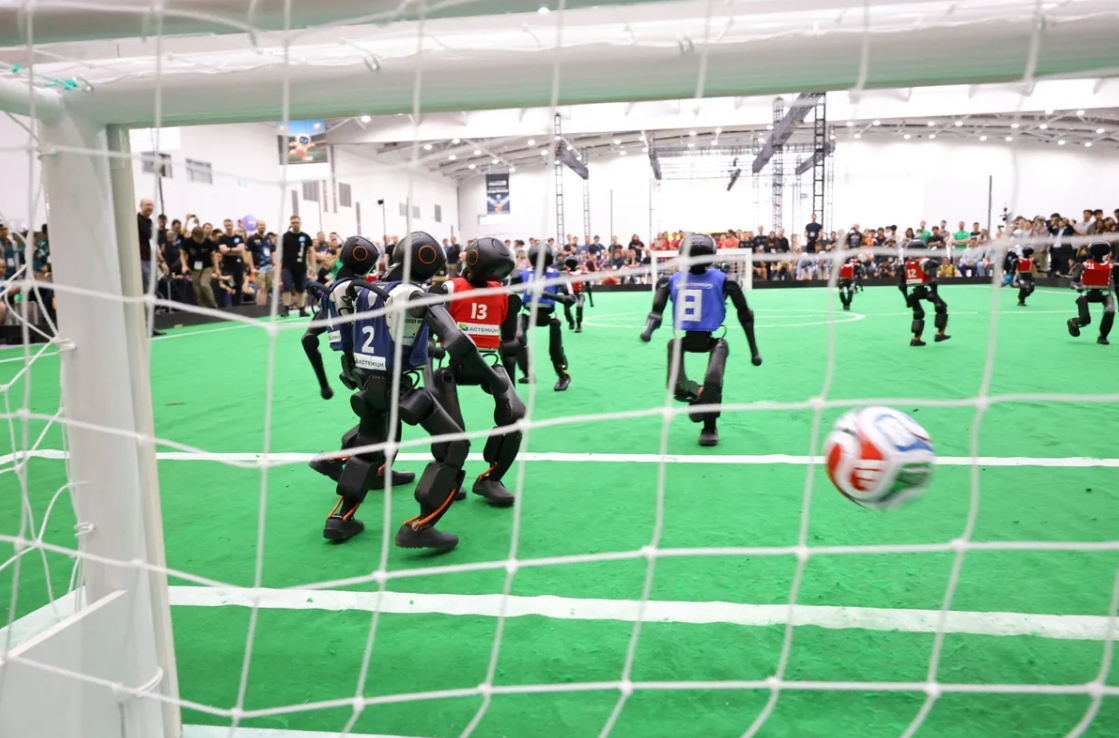
Robotics has taken another major step forward as humanoid robots competed in the first-ever full-scale 11 vs. 11 robot soccer match.
The historic event demonstrated how far humanoid robotics has advanced, with multiple robots working together, making decisions, and interacting in a complex environment similar to human sports.
Although robot soccer is still an experimental field, it provides researchers with a valuable platform to improve mobility, coordination, artificial intelligence, and real-world problem-solving.
Humanoid Robots Enter the Sports Arena
The robot soccer match, organized as part of RoboCup 2026, marked the first time two complete teams of humanoid robots competed against each other.
Unlike traditional robots designed for fixed tasks, humanoid robots must handle unpredictable environments. They need to:
- Maintain balance while moving
- Recognize objects and surroundings
- Plan actions in real time
- Cooperate with teammates
- Adapt to changing situations
These challenges make robot soccer an important testing ground for future general-purpose robots.
Robots That Can Move Beyond the Ground
Researchers are also exploring new forms of robotic movement.
Engineers from MIT and EPFL developed a robot inspired by diving birds that can both swim underwater and transition into flight.
This type of aerial-aquatic robot could eventually support applications such as:
- Environmental research
- Ocean exploration
- Search and rescue missions
- Autonomous inspection
The project demonstrates how robotics is expanding beyond traditional land-based machines.
More Human-Like Robotic Hands
One of the biggest challenges in humanoid robotics is creating hands capable of human-level interaction.
New robotic hand systems are now combining:
- Multiple degrees of freedom
- Advanced tactile sensors
- Flexible mechanical structures
- Precise force control
These improvements allow robots to perform delicate tasks, manipulate tools, and interact more safely with humans.
Better robotic hands are considered a key technology for future household, industrial, and service robots.
AI Is Making Robots Smarter
Modern robotics is increasingly powered by artificial intelligence.
New AI systems are helping robots learn physical skills through:
- Reinforcement learning
- Simulation training
- Vision-based models
- Real-world demonstrations
Some researchers have achieved significant improvements in robot learning speed and task accuracy, bringing general-purpose robots closer to practical use.
From Factories to Everyday Life
Humanoid robots are no longer limited to laboratory demonstrations.
Companies are now exploring robots for:
- Manufacturing
- Logistics
- Home assistance
- Infrastructure inspection
- Public safety
Robots are gradually becoming more capable of operating in environments designed for humans.
However, challenges remain, including cost, safety, reliability, and the ability to handle unpredictable situations.
The Future of Humanoid Robotics
The robot World Cup is more than a sporting event. It represents a major experiment in building machines that can understand, move, and interact with the physical world.
As artificial intelligence and robotics continue to merge, humanoid robots may eventually become valuable partners in everyday life.
The future of robotics will not only be about smarter software, but also about creating machines that can physically participate in the world around us.
