

Neuroscience Could Help Robots Learn Human Skills Faster
Artificial intelligence has achieved remarkable progress in language, image generation, and software automation. However, teaching machines to interact with the physical world remains one of the biggest challenges in modern AI.
Unlike chatbots that learn from massive amounts of online text, robots require something far more complicated: real-world experience.
A robot must understand how objects move, how hands interact with environments, and how humans make decisions during physical tasks.
Now, researchers and startups are exploring a new possibility: using human brain activity as additional training data for robots.
Companies working on physical AI believe brain signals could provide valuable information about human intention, mistakes, and decision-making, helping future robots become more capable.
The Data Challenge Behind Physical AI
Large language models became powerful because they were trained on enormous amounts of digital information.
The internet provided billions of examples of:
- Text
- Images
- Code
- Documents
However, robots face a different problem.
Physical intelligence requires understanding the real world.
A humanoid robot learning to pick up objects needs data about:
- Hand movements
- Force control
- Object interaction
- Human decision-making
- Environmental changes
This type of data cannot simply be downloaded from the internet.
It must be created through real-world demonstrations.
According to robotics researchers, the lack of high-quality physical training data is becoming one of the biggest barriers to advancing humanoid robots.
How Brain Waves Could Improve Robot Learning
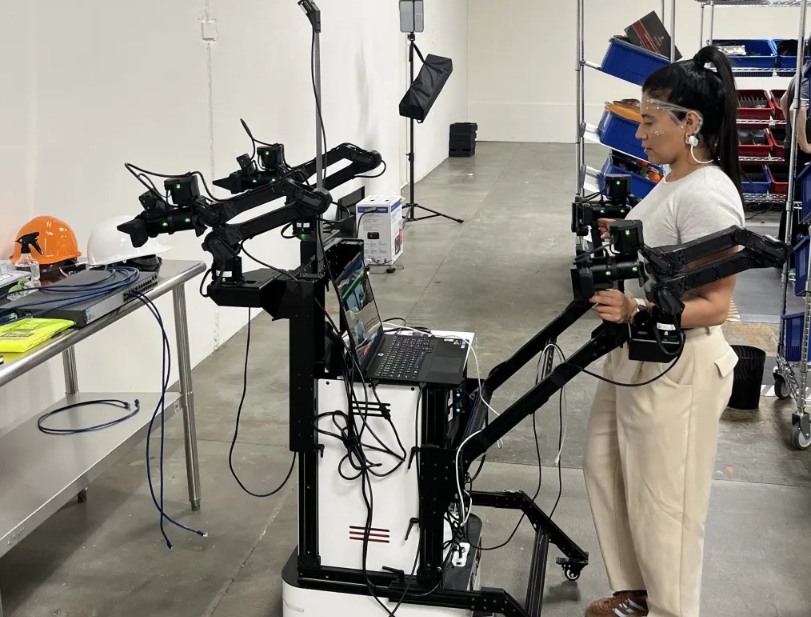
At a robotics training facility in San Leandro, California, AI data company Encord is experimenting with a new approach.
Human operators, known as robotic trainers, perform physical tasks while wearing specialized headsets that record brain activity.
The goal is not to read thoughts directly but to capture signals related to:
- Intent
- Attention
- Errors
- Surprise
- Decision-making
These additional signals could help AI models understand not only what humans do but also why they do it.
For example:
A human may quickly adjust their hand position after noticing an object is unstable.
A camera can capture the movement.
But brain activity could provide additional information showing that the person detected a mistake and corrected it.
This extra context could make robot learning more efficient.
From Human Demonstrations to Robot Intelligence
Traditional robot training often relies on visual data.
Cameras record humans performing tasks, and AI models learn from those examples.
This approach is known as egocentric data collection, where cameras capture the world from a person’s perspective.
Examples include:
- Picking up objects
- Preparing food
- Operating tools
- Connecting cables
- Organizing items
However, video alone has limitations.
A camera can see what happened, but it may not understand:
- Human intention
- Level of difficulty
- Decision-making process
- Internal correction signals
Adding brain and muscle sensors could provide a richer dataset.
The Rise of Data Manufacturing for Robots
For software AI, collecting training data is relatively inexpensive.
Large language models can learn from existing online information.
Physical AI is different.
Robot training data must often be created manually through:
- Human demonstrations
- Remote robot operation
- Sensor recordings
- Detailed annotations
This has created a new industry focused on manufacturing AI training data.
Companies like Encord are building specialized environments where humans perform thousands of physical tasks to teach robots how to operate.
Beyond Brain Waves: New Ways to Capture Human Movement
Brain activity is only one part of the emerging physical AI training ecosystem.
Researchers are also exploring other data sources.
Muscle Sensors
Sensors attached to the arm can detect electrical signals from muscles.
These signals may help AI models understand:
- Hand position
- Movement patterns
- Grip strength
- Fine motor control
This could be especially useful for training robots to perform precise tasks.
Robot Teleoperation
Another approach uses human operators controlling robotic systems remotely.
The robot records:
- Human movements
- Applied force
- Object interactions
These demonstrations can later be used to train autonomous systems.
Advanced Simulation
Virtual environments are also becoming important.
AI researchers create simulated worlds where robots can practice millions of tasks before operating in reality.
However, real-world data remains essential because physical environments contain unpredictable situations.
Why Humanoid Robots Need Better Data
Humanoid robots are designed to perform tasks in environments created for humans.
This includes:
- Homes
- Warehouses
- Factories
- Offices
But human environments are extremely complex.
Simple actions for people can be difficult for robots.
Examples:
- Opening a door
- Folding clothes
- Pouring liquids
- Handling fragile objects
- Connecting electronic components
Human intelligence comes from years of physical experience.
The challenge for AI researchers is finding ways to transfer that knowledge to machines.
The Future of Brain-Enhanced Robotics
Brain-wave-assisted robot training is still in an experimental stage.
Several challenges remain:
- Cost of collecting neural data
- Accuracy of brain signal interpretation
- Privacy concerns
- Scaling human demonstrations
- Integrating different sensor systems
However, the concept represents a major shift in robotics development.
Future robots may not only learn from cameras and commands but also from deeper signals associated with human decision-making.
The Next Era of Physical AI
The future of robotics may depend on creating a new relationship between humans and machines.
Instead of programming robots line by line, engineers are teaching them through experience, observation, and biological signals.
The combination of:
- Artificial intelligence
- Neuroscience
- Robotics
- Human demonstration data
could become the foundation for the next generation of intelligent machines.
Brain waves may not replace traditional robot training, but they could become another powerful tool helping robots understand the physical world.
