

Physical AI Could Transform the Future of Renewable Energy Infrastructure
The global transition toward renewable energy is accelerating, with solar power becoming one of the fastest-growing sources of electricity worldwide.
However, expanding solar energy infrastructure faces a major challenge: not enough workers are available to install the massive number of panels required.
Now, a new generation of AI-powered construction robots may provide a solution.
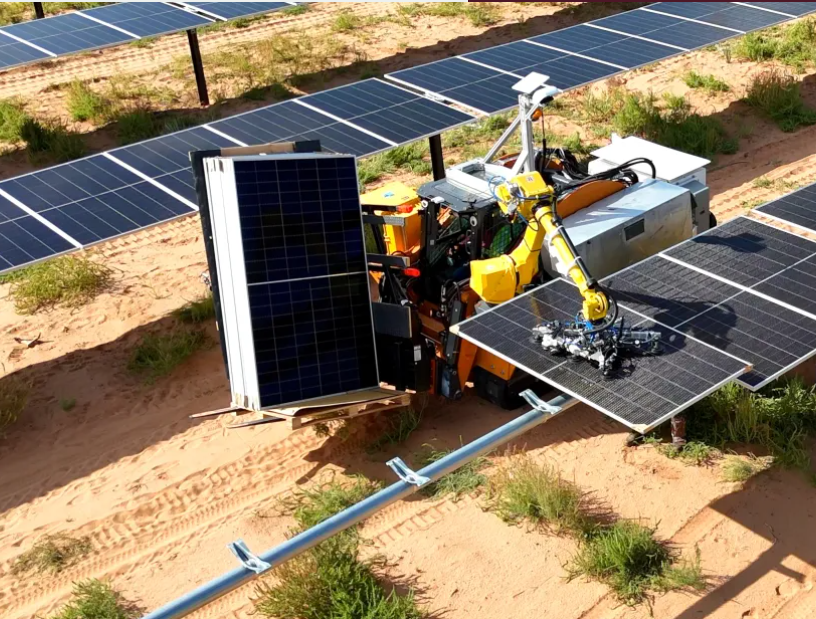
Startup Gritt has emerged from stealth with millions in funding to develop intelligent robotic systems designed to help build solar farms faster, safer, and more efficiently.
The company believes that combining robotics, computer vision, and advanced AI models could transform not only solar installation but the future of construction itself.
The Growing Challenge of Solar Infrastructure
Solar energy deployment has reached unprecedented levels as governments and companies invest heavily in renewable power.
Large-scale solar projects require thousands or even millions of panels to be installed across wide areas.
However, construction companies face several challenges:
- Labor shortages
- Physically demanding work
- Remote project locations
- Safety risks
- Slow installation processes
Installing solar panels often requires workers to repeatedly lift heavy equipment, work outdoors in harsh conditions, and perform highly repetitive tasks.
Robotics could help solve these problems by taking over the most physically demanding parts of the process.
How Gritt’s AI Robots Work
Unlike traditional industrial robots that operate in controlled factory environments, Gritt’s systems are designed for unpredictable outdoor construction sites.
The company uses existing robotic hardware, including industrial robotic arms and construction vehicles, combined with its own AI software platform.
The system uses:
- Computer vision
- Machine learning
- Autonomous navigation
- Robotic manipulation
- Real-time environmental understanding
The goal is to allow robots to operate in complex environments where conditions constantly change.
From Solar Panels to Autonomous Construction
Gritt’s first application focuses on solar panel installation.
The robots can help with tasks such as:
- Transporting solar panels
- Positioning panels on mounting structures
- Aligning components with high precision
- Assisting human workers during installation
The company says its systems can significantly increase installation efficiency.
A traditional eight-person crew may install hundreds of panels per day, while teams using robotic assistance could potentially increase output several times.
Why Physical AI Is Changing Robotics
For decades, robots performed best in predictable environments such as factories.
Industrial robots could repeat the same movement thousands of times but struggled with unexpected situations.
Construction sites are completely different.
They include:
- Uneven terrain
- Changing weather conditions
- Different materials
- Unpredictable obstacles
Recent advances in AI are changing this limitation.
Modern AI models allow robots to better understand their surroundings, adapt to new situations, and learn new tasks more quickly.
This represents the rise of Physical AI — artificial intelligence that operates in the real world.
Robots Could Help Solve Labor Shortages
One of the biggest advantages of construction robotics is improving productivity without replacing human expertise.
Future construction teams may combine:
- Human decision-making
- Robotic physical labor
- AI-powered planning systems
Workers could focus on higher-value tasks while robots handle repetitive, dangerous, or physically demanding operations.
This could be especially valuable for:
- Solar farms
- Wind energy projects
- Infrastructure construction
- Remote industrial sites
Supporting the Renewable Energy Revolution
The future of clean energy depends not only on developing better solar technology but also on building infrastructure faster.
AI-powered construction robots could accelerate:
- Solar farm deployment
- Renewable energy expansion
- Grid modernization
- Energy independence projects
As demand for renewable energy increases, automation may become a critical part of scaling clean energy worldwide.
Beyond Solar Panels: The Future of Robotic Construction
Gritt’s long-term vision extends beyond solar installation.
The company believes its AI systems could eventually perform many other construction tasks, including:
- Building support structures
- Drilling foundations
- Installing components
- Managing construction materials
- Performing infrastructure maintenance
Future construction sites could become intelligent environments where robots continuously collect information, perform physical work, and help managers make better decisions.
The Next Era of Industrial Robotics
The combination of AI and robotics is creating a new generation of machines capable of operating outside traditional factories.
From renewable energy construction to advanced manufacturing, autonomous systems may become essential tools for building the infrastructure of the future.
Gritt’s approach represents a broader industry shift:
Robots are no longer just machines that repeat tasks.
They are becoming intelligent systems that can understand environments, learn new skills, and work alongside humans.
