

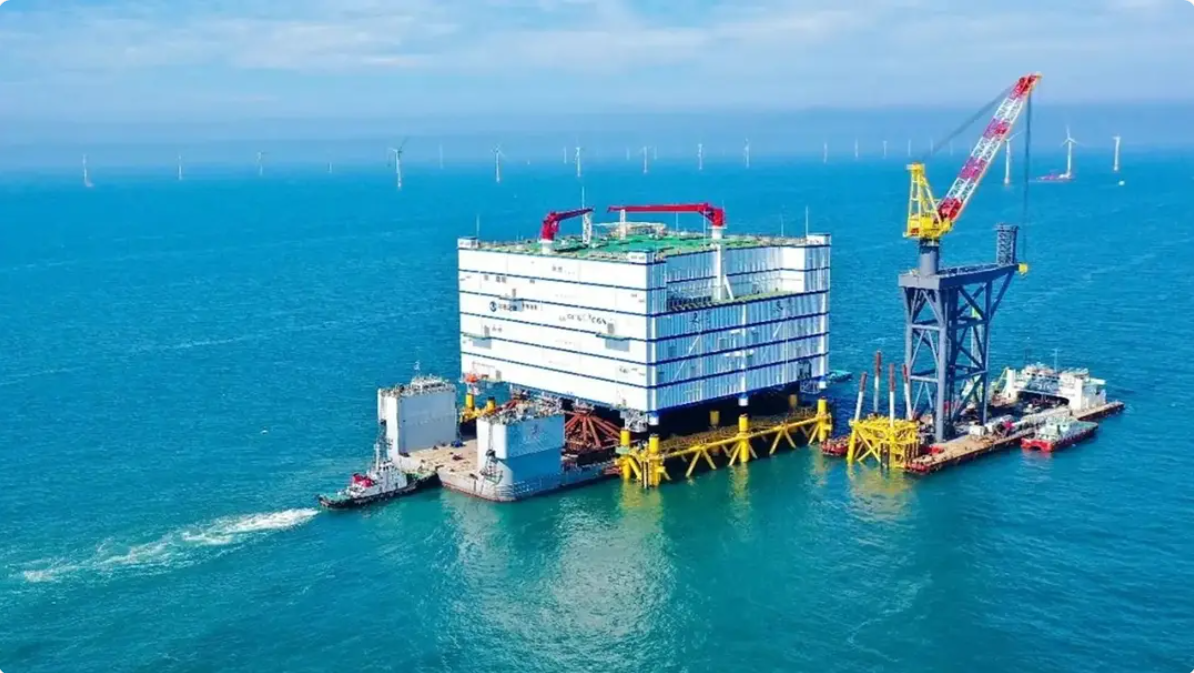
Massive Energy Platform Could Deliver 6 Billion kWh of Clean Electricity Every Year
As countries accelerate the transition toward renewable energy, offshore wind power is becoming one of the most important sources of large-scale clean electricity.
However, generating electricity far offshore creates a major engineering challenge: efficiently transporting huge amounts of power back to land.
China has now completed one of the world’s largest offshore converter stations, a massive offshore energy platform designed to collect electricity from wind farms and transmit it to the mainland power grid.
The project represents a major advancement in offshore renewable energy infrastructure.
The “Heart of Offshore Wind”
The newly installed offshore converter station is located in the South China Sea, approximately 100 kilometers from the coast of Yangjiang, Guangdong.
The seven-story steel structure weighs around 25,000 metric tons, making it one of the largest offshore energy platforms ever constructed.
The platform serves as the central connection point between offshore wind turbines and the mainland electricity network.
Its role is similar to a giant offshore power hub.
How Offshore Converter Stations Work
Offshore wind farms generate electricity far from shore.
While individual turbines produce power efficiently, transmitting electricity over long distances requires advanced technology.
Converter stations help solve this problem by:
- Collecting electricity from multiple wind turbines
- Converting electrical signals into a transmission-friendly format
- Sending electricity through subsea cables
- Delivering clean power to coastal grids
Many large offshore projects rely on high-voltage direct current (HVDC) technology because it reduces energy losses during long-distance transmission.
Delivering Billions of Kilowatt-Hours of Clean Energy
The offshore converter station is expected to transmit approximately 6 billion kWh of clean electricity every year.
This amount of renewable energy could support large-scale electricity demand while reducing reliance on fossil fuels.
Large offshore wind projects can provide:
- Low-carbon electricity
- Stable renewable generation
- Reduced greenhouse gas emissions
- Greater energy security
Engineering Challenges of Offshore Energy
Building massive offshore infrastructure requires solving complex engineering problems.
Extreme Marine Conditions
The platform must withstand:
- Strong winds
- Large waves
- Corrosion
- Long-term underwater exposure
Heavy Construction Requirements
The structure requires:
- Advanced steel engineering
- Precision manufacturing
- Specialized offshore installation equipment
Long-Distance Power Transmission
Engineers must minimize electricity losses while transporting power across long underwater distances.
The Future of Offshore Wind Infrastructure
As offshore wind farms expand, converter stations will become increasingly important.
Future offshore energy systems may include:
- Larger wind turbines
- Floating offshore platforms
- Smart energy networks
- AI-powered grid management
- Hybrid renewable systems
These technologies could allow countries to generate clean electricity far beyond their coastlines.
Offshore Wind as a Global Energy Solution
Offshore wind has several advantages compared with traditional renewable systems.
Compared with land-based wind farms, offshore projects often benefit from:
- Stronger and more consistent winds
- Larger available areas
- Reduced land-use conflicts
However, they require more advanced engineering and higher construction investment.
Building the Next Generation of Clean Energy Networks
The development of giant offshore converter stations shows that renewable energy is no longer limited by electricity generation alone.
The future challenge is building the infrastructure needed to transport and manage clean power at massive scales.
From offshore wind platforms to smart grids and energy storage systems, the next generation of energy technology will depend on advanced engineering solutions.
The world’s largest offshore converter station represents another step toward a cleaner and more connected energy future.
